AI Under Adversity: Robust, Explainable, and Secure Systems for High-Stakes Environments
The Trustworthy and Secure AI (TSAI) Lab conducts research on the foundations, methodologies, and applications of trustworthy artificial intelligence for security-critical and high-stakes environments. Our mission is to advance robust, secure, explainable, privacy-preserving, dependable, and safety-aware AI systems capable of operating under adversarial, uncertain, distributed, and nonstationary conditions.
The lab’s core research directions include trustworthy and secure AI, adversarial machine learning, AI for cybersecurity, self-adaptive and continual learning, federated and transfer learning, graph intelligence for software and malware analysis, and intelligent decision-making under uncertainty. We are also actively exploring emerging directions in quantum machine learning and quantum adversarial AI.
Through interdisciplinary collaborations with academia, industry, and research organizations, the TSAI Lab develops next-generation intelligent systems and learning methodologies for resilient and secure AI, cybersecurity, cyber-physical systems (CPS), and Internet of Things (IoT) environments.
Lab Director, Associate Professor, SMIEEE
Postdoctoral Fellow
Research Focus:
Machine Learning • Federated Learning • Adversarial ML
MCS Student
MCS Student
MCS Student
MCS Student
MCS Student (Co-supervised)
MCS Student
MCS Student
We welcome collaborations with academic institutions, industry partners, research organizations, and professional communities to advance trustworthy and secure AI research and innovation.
View Partners & Collaborators →At TSAI Lab, we conduct research on trustworthy, secure, and dependable artificial intelligence systems designed for adversarial, uncertain, and high-stakes environments. Our work spans adversarial machine learning, secure AI, AI for cybersecurity, explainable graph learning, federated and distributed learning, self-adaptive learning, and resilient AI for cyber-physical and data-intensive systems.

This project focuses on secure and adversarial machine learning for developing trustworthy, resilient, and quantum-aware AI systems operating under malicious, uncertain, and imperfect conditions. We investigate defense mechanisms against adversarial attacks, data poisoning, backdoor threats, and compromised learning processes in centralized and distributed environments, including federated, split, and quantum machine learning settings. Our research explores privacy-preserving security, robust optimization, quantum adversarial machine learning, blockchain-enabled trust mechanisms, and resilient learning strategies to improve the reliability, integrity, robustness, and adaptability of AI systems deployed in safety- and security-critical applications.
This project focuses on trustworthy AI-driven cybersecurity and threat detection for malware analysis, software security, and intrusion detection in cyber-physical systems (CPSs) and Internet of Things (IoT) environments. We develop scalable and explainable machine learning, large language model, and graph neural network frameworks for malware reverse engineering, graph-based threat analysis, anomaly detection, and coordinated attack detection. Our goal is to advance robust and interpretable AI technologies for critical infrastructure protection, cyber resilience, and intelligent next-generation defense systems.
This project investigates adaptive continual learning in complex and evolving environments where learning systems must operate under changing data characteristics, limited supervision, noisy observations, and emerging or reappearing categories. Rather than addressing these challenges independently, we study unified self-adaptive learning paradigms capable of monitoring their own performance and adjusting behavior autonomously.
This project focuses on AI-driven methods for safe, reliable, and resilient operation of cyber-physical systems (CPSs) and Internet of Things (IoT) environments. We develop machine learning and deep learning frameworks for fault diagnosis, anomaly detection, and failure prediction under harsh and noisy operating conditions. Our research investigates robust feature-learning, clustering, and knowledge-distillation techniques for accurate and lightweight edge intelligence, enabling early fault detection, resilient decision-making, and dependable operation in smart-grid and industrial systems.
This project focuses on intelligent group decision-making and secure consensus formation in distributed and safety-critical systems. We develop mathematical frameworks that integrate consensus theory, reinforcement learning, and blockchain-enabled trust mechanisms for reliable opinion fusion under uncertainty and adversarial conditions. Our research investigates transparent, explainable, and resilient consensus models for distributed decision intelligence, with applications to fault diagnosis, intrusion detection, and trustworthy coordination in cyber-physical and industrial systems.
This project focuses on the development of novel machine learning approaches that can learn from stream data collected from non-stationary environments and make decisions under harshest learning conditions. We tackle various challenges including noisy data, high-dimensional data, and missing data, learning from skewed-class distributions with the rarity of labeled data, novelty detection, and handling extreme verification latency.
Explainable Artificial Intelligence (XAI) tries to produce explainable models enabling users to appropriately trust and interpret the attained results and reveal the model functionalities. There has been an increasing need for XAI in various applications, such as cyber-physical energy systems, autonomous vehicles, and healthcare. This project aims to develop explainable artificial intelligence models and assessment criteria for smart energy management, prognostic and health management in cyber-physical energy and power systems.
The welfare and security of modern societies rely on the safe and secure operation of complex safety-critical cyber-physical systems (CPSs). CPSs dependency on digitalization, wireless communication, and remote control systems increases their vulnerabilities to malicious threats, which lead to the loss of system integrity and functionality. This project focuses on integrating the knowledge on machine learning, big data analytics, cybersecurity, and cybernetics that would pave the way together towards fault-tolerant attack-resilient CPSs.
Nowadays, almost every aspect of technology—from mobile devices to smart grids and multi-agent control systems—is impacted by the integration of computational intelligence with the communication systems networks. This phenomenon has brought about a vast variety of challenges to modern cyber-physical systems from a security viewpoint. The objective of the proposed research is to discover novel methods to secure computational models during construction, calibration, and communication. The outcome of this research will guarantee the safe and secure operation of the new generation of dynamic intelligent systems that are more vulnerable to malicious cyber-activities.
Missing data are inevitable in almost all industries and highly undesirable in machine learning, data mining, and information systems. There exist a number of reasons for this severe deficiency, including imperfect procedures of manual data entry, incorrect measurements, data collection problems, and equipment errors. This project focuses on the development of efficient algorithms for the treatment of missing data in order to improve decision-making.
Razavi-Far, R., Meymani, M., Mahmoudinia, E., Vazirzade, D., Paknezhad, P., Ghasemi, F., Saravani, S., Nikkhoo, S., Haghjooei, K., “Quantum adversarial machine learning: from classical adaptations to quantum-native methods,” in Artificial Intelligence Review, 2026 (in press).
Vashagh, A., Razavi-Far, R., Meymani, M., Biggio, B., “Recent advances in adversarial attacks on model utility, privacy, and explainability: A comprehensive survey,” in Authorea Preprints, 2026.
Meymani, M., Razavi-Far, R., “Divided we fall: defending against adversarial attacks via soft-gated fractional mixture-of-experts with randomized adversarial training,” in Information Sciences, 745, pp. 123427, 2026.
Higgins, G., Razavi-Far, R., Zhang, X., David, A., Ghorbani, A., Ge, T., “Towards privacy-preserving split learning: destabilizing adversarial inference and reconstruction attacks in the cloud”, Internet of Things, 31, p. 101558, 2025.
Hallaji, E., Razavi-Far, R., Saif, M., “TrustChain: A blockchain framework for auditing and verifying aggregators in decentralized federated learning”, in IEEE Transactions on Big Data, in press, 2025.
Zhang, X., Razavi-Far, R., Isah, H., David, A., Higgins, G., Zhang, M., “A survey on deep learning in edge-cloud collaboration: model partitioning, privacy preservation, and prospects”, in Knowledge-based Systems, 310, p. 112965, 2025.
Hallaji, E. Razavi-Far, R. Saif, M., “FedNIA: Noise-Induced Activation Analysis for Mitigating Data Poisoning in FL”, Submitted to IEEE Transactions on Neural Networks and Learning Systems, revision requested, 2025.
Hallaji, E., Razavi-Far, R., Saif, M., Wang, B., Yang, Q., “Decentralized federated learning: A survey on security and privacy”, in IEEE Transactions on Big Data, 10(2), pp. 194-213, 2024.
Hallaji, E., Razavi-Far, R., Saif, M., Herrera-Viedma, E., “Label noise analysis meets adversarial training: a defense against label poisoning in federated learning”, in Knowledge-Based Systems, 266, pp. 110384, 2023.
Jelodar, H., Bai, S., Nwankwo, T.E., Hamedi, P., Meymani, M., Razavi-Far, R., Ghorbani, A., "LLM4CodeRE: Generative AI for code decompilation analysis and reverse engineering", in IEEE World Congress on Computational Intelligence (IEEE WCCI), International Joint Conference on Neural Networks (IJCNN), pp. 1-6, Maastricht, the Netherlands, June 21-26, 2026.
Higgins, G., Razavi-Far, R., Shokouhinejad, H., Ghorbani, A., “Towards transparent malware detection with granular explainability: Backtracking meta-coarsened explanations onto assembly flow graphs with graph neural networks”, arXiv preprint arXiv:2601.14511, 2026.
Jelodar, H., Bai, S., Meymani, M., Hamedi, P., Razavi-Far, R., Ghorbani, A., "Integrating graphs, large language models, and agents: reasoning and retrieval", arXiv preprint arXiv:2604.15951, 2026.
Jelodar, H., Bai, S., Hamedi, P., Mohammadian, H., Razavi-Far, R., Ghorbani, A., "large language model (LLM) for software security: code analysis, malware analysis, reverse engineering", in Journal of Information Security and Applications, 98, p. 104390, 2026.
Yousefimehr, B., Ghatee, M., Razavi-Far, R., “Multi-teacher knowledge distillation framework for lightweight anomaly detection”, in Neural Networks, 195, p. 108267, 2026.
Shokouhinejad, H., Razavi-Far, R., Higgins, G., Ghorbani, A., “Dual explanations via subgraph matching for malware detection”, in Engineering Applications of Artificial Intelligence, 178, pp. 115049, 2026.
Shokouhinejad, H., Razavi-Far, R., Higgins, G., Ghorbani, A., “Routing-aware explanations for mixture of experts graph models in malware detection”, arXiv preprint arXiv:2602.19025, 2026.
Shokouhinejad, H., Razavi-Far, R., Higgins, G., Ghorbani, A., “Explainable attention-guided stacked graph neural networks for malware detection”, arXiv preprint arXiv:2508.09801, 2026.
Hamedi, P., Jelodar, H., Bai, S., Meymani, M., Razavi-Far, R., Ghorbani, A., "Asm2Src-LLMEval: A GenAI framework for systematic evaluation of LLMs on code tasks", in IEEE Conference on Artificial Intelligence (IEEE CAI), Granada, Spain, 2026.
Jelodar, H., Bai, S., Razavi-Far, R., Ghorbani, A., “FlexiDataGen: An adaptive llm framework for dynamic semantic dataset generation in sensitive domains”, in IEEE Conference on Artificial Intelligence (IEEE CAI), Granada, Spain, 2026.
Jelodar, H., Meymani, M., Bai, S., Razavi-Far, R., Ghorbani, A., “SBAN: A framework and multi-dimensional dataset for large language model pre-training and software code mining”, in 25th IEEE International Conference on Data Mining (ICDM), Washington DC, USA, pp. 1293-1299, 2025.
Shokouhinejad, H., Higgins, G., Razavi-Far, R., Ghorbani, A., “A Research and Development Portfolio of GNN Centric Malware Detection, Explainability, and Dataset Curation”, in IEEE International Conference on Data Mining Workshops (ICDMW), Washington, DC, USA, pp. 1070-1075, 2025.
Yousefimehr, B., Ghatee, M., Razavi-Far, R., “Multi-stage self-distillation for class-imbalanced fraud and cyberattack detection”, in IEEE Transactions on Emerging Topics in Computational Intelligence, accepted for publication, 2025.
Shokouhinejad, H., Razavi-Far, R., Mohammadian, H., Rabbani, M., Ansong, S., Higgins, G., Ghorbani, A., “Recent advances in malware detection: graph learning and explainability”, arXiv:2502.10556, 2025.
Mohammadi, H., Higgins, G., Ansong, S., Razavi-Far, R., Ghorbani, A., “Explainable malware detection through integrated graph reduction and learning techniques”, in Big Data Research, 41, p. 100555, 2025.
Shokouhinejad, H., Higgins, G., Razavi-Far, R., Mohammadian, H., Ghorbani, A., “On the consistency of GNN explanations for malware detection”, in Information Sciences, 721, p. 122603, 2025.
Hamedi, P., Jelodar, H., Bai, S., Meymani, M., Razavi-Far, R., Ghorbani, A., “Asm2SrcEval: Evaluating large language models for assembly-to-source code translation”, in 4th Workshop on Deep Learning for Code (DL4C), Conference on Neural Information Processing Systems (NeurIPS), San Diego, USA, 2025.
Jelodar, H., Meymani, M., Hamedi, P., Nwankwo, T.E., Bai, S., Razavi-Far, R., Ghorbani, A., “NLD-LLM: A systematic framework for evaluating small language transformer models on natural language description”, in 24th IEEE International Conference on Machine Learning and Applications (ICMLA), Boca Raton, Florida, USA, pp. 1494-1500, 2025.
Jelodar, H., Meymani, M., Razavi-Far, R., Ghorbani, A., “XGen-Q: An explainable domain-adaptive LLM framework with retrieval-augmented generation for software security”, arXiv preprint arXiv:2510.19006, 2025
Hallaji, E., Razavi-Far, R., Saif, M., “Expanding analytical capabilities in intrusion detection through ensemble-based multi-label classification”, in Computers \& Security, 139, pp. 103730, 2024.
Farajzadeh-Zanjani, M., Hallaji, E., Razavi-Far, R., Saif, M., “Generative-adversarial class-imbalance learning for classifying cyber-attacks and faults - a cyber-physical power system,” in IEEE Transactions on Dependable and Secure Computing, 19(6), pp. 4068-4081, 2022.
Farajzadeh-Zanjani, M., Hallaji, E., Razavi-Far, R., Saif, M., Parvania, M., “Adversarial semi-supervised learning for diagnosing faults and attacks in power grids,” in IEEE Transactions on Smart Grid, 12(4), pp. 3468-3478, 2021.
Razavi-Far, R., et. al., "Towards Self-Adaptive Learning: Continual Learning under Harsh Conditions", Accepted for Publication in Neurocomputing, 2026.
Fathalizadeh, A., Razavi-Far, R., “Proxy-anchor and EVT-driven continual learning method for generalized category discovery”, in Transactions on Machine Learning Research (TMLR), 2026.
Hamedi, P., Razavi-Far, R., Hallaji, E., “Federated continual learning: concepts, challenges, and solutions”, in Neurocomputing Journal, 651, 130844, 2025.
Razavi-Far, R., Wan, D., Saif, M., Mozafari, N., “To tolerate or to impute missing values in V2X communications data?,” in IEEE Internet of Things Journal, 9(13), pp. 11442-11452, 2022.
Farajzadeh-Zanjani, M., Hallaji, E., Razavi-Far, R., Saif, M., “Generative-adversarial class-imbalance learning for classifying cyber-attacks and faults - a cyber-physical power system,” in IEEE Transactions on Dependable and Secure Computing, 19(6), pp. 4068-4081, 2022.
Farajzadeh-Zanjani, M., Hallaji, E., Razavi-Far, R., Saif, M., Parvania, M., “Adversarial semi-supervised learning for diagnosing faults and attacks in power grids,” in IEEE Transactions on Smart Grid, 12(4), pp. 3468-3478, 2021.
Farajzadeh-Zanjani, M., Hallaji, E., Razavi-Far, R., Saif, M., “Generative adversarial dimensionality reduction for diagnosing faults and attacks in cyber-physical systems,” in Neurocomputing, 440, pp. 101-110, 2021.
Razavi-Far, R., Farajzadeh-Zanajni, M., Saif, M., Chakrabarti, S. “Correlation clustering imputation for diagnosing attacks and faults with missing power grid data”. IEEE Transactions on Smart Grid, 11(2), pp. 1453-1464, 2020.
Hallaji, E., Razavi-Far, R., Saif, M., “Detection of malicious SCADA communications via multi-subspace feature selection”. in IEEE World Congress on Computational Intelligence (IEEE WCCI), International Joint Conference on Neural Networks (IJCNN), pp. 1-8, Glasgow, United Kingdom, July 19-24, 2020.
Hassani, H., Razavi-Far, R., Saif, M., Herrera-Viedma, E., “Blockchain-enabled trust building for managing consensus in linguistic opinion dynamics”, in IEEE Transactions on Fuzzy Systems, 31(8), pp. 2722-2733, 2023.
Hassani, H., Razavi-Far, R., Saif, M., Herrera-Viedma, E., “Reinforcement learning-based feedback and weight-adjustment mechanisms for consensus reaching in group decision-making”, in IEEE Transactions on Systems, Man, and Cybernetics: Systems, 53 (4), pp. 2456-2468, 2023.
Hassani, H., Razavi-Far, R., Saif, M., Chiclana, F., Krejcar, O., Herrera-Viedma, E., “Classical dynamic consensus and opinion dynamics models: A survey of recent trends and methodologies”, in Information Fusion, 88, pp. 22-40, 2022.
Hassani, H., Razavi-Far, R., Saif, M., Herrera-Viedma, E., “Consensus-based decision support model and fusion architecture for dynamic decision making”. in Information Sciences, 597, pp. 86-104, 2022.
Hassani, H., Razavi-Far, R., Saif, M., “Fault location in smart grids through multicriteria analysis of group decision support systems”. IEEE Transactions on Industrial Informatics, 16(12), pp. 7318-7327, 2020.
Hassani, H., Hallaji, E. Razavi-Far, R. Saif, M., “Learning from high-dimensional cyber-physical data streams: a case of large-scale smart grid”, in International Journal of Machine Learning and Cybernetics, 16(3), pp. 1819-1831, 2025.
Hallaji, E., Razavi-Far, R., Wang, M., Saif, M., Fardanesh, B., “A stream learning approach for real-time identification of false data injection attacks in cyber-physical power systems”, in IEEE Transactions on Information Forensics and Security,17, pp. 3943-3945, 2022.
Razavi-Far, R., Hallaji, E., Saif, M., Ditzler, G. “A novelty detector and extreme verification latency model for nonstationary environments”. IEEE Transactions on Industrial Electronics, 66(1), pp. 561-570, 2019.
Higgins, G., Razavi-Far, R., Shokouhinejad, H., Ghorbani, A., “Towards transparent malware detection with granular explainability: Backtracking meta-coarsened explanations onto assembly flow graphs with graph neural networks”, arXiv:2601.14511, 2026.
Shokouhinejad, H., Razavi-Far, R., Higgins, G., Ghorbani, A., “Dual explanations via subgraph matching for malware detection”, in Engineering Applications of Artificial Intelligence, 178, pp. 115049, 2026.
Shokouhinejad, H., Razavi-Far, R., Higgins, G., Ghorbani, A., “Routing-aware explanations for mixture of experts graph models in malware detection”, arXiv:2602.19025, 2026.
Shokouhinejad, H., Razavi-Far, R., Higgins, G., Ghorbani, A., “Explainable attention-guided stacked graph neural networks for malware detection”, arXiv:2508.09801, 2026.
Shokouhinejad, H., Razavi-Far, R., Mohammadian, H., Rabbani, M., Ansong, S., Higgins, G., Ghorbani, A., “Recent advances in malware detection: graph learning and explainability”, arXiv:2502.10556, 2026.
Shokouhinejad, H., Higgins, G., Razavi-Far, R., Ghorbani, A., “A Research and Development Portfolio of GNN Centric Malware Detection, Explainability, and Dataset Curation”, in IEEE International Conference on Data Mining Workshops (ICDMW), Washington, DC, USA, pp. 1070-1075, 2025.
Mohammadi, H., Higgins, G., Ansong, S., Razavi-Far, R., Ghorbani, A., “Explainable malware detection through integrated graph reduction and learning techniques”, in Big Data Research, 41, p. 100555, 2025.
Shokouhinejad, H., Higgins, G., Razavi-Far, R., Mohammadian, H., Ghorbani, A., “On the consistency of GNN explanations for malware detection”, in Information Sciences, 721, p. 122603, 2025.
Hassani, H., Razavi-Far, R., Saif, M., “Real-time out-of-step prediction control to prevent emerging blackouts in power systems: A reinforcement learning approach,”. in Applied Energy, 314, pp. 118861, 2022.
Hassani, H., Hallaji, E., Razavi-Far, R., Saif, M., “Unsupervised concrete feature selection based on mutual information for diagnosing faults and cyber-attacks in power systems,” Engineering Applications of Artificial Intelligence, 100, pp. 104150, 2021.
Hassani, H., Razavi-Far, R., Saif, M., Capolino, G.A., “Regression models with graph-regularization learning algorithms for accurate fault location in smart grids”. IEEE Systems Journal, 15(2), pp. 2012-2023, 2021.
Razavi-Far, R., Farajzadeh-Zanajni, M., Saif, M., Chakrabarti, S. “Correlation clustering imputation for diagnosing attacks and faults with missing power grid data”. IEEE Transactions on Smart Grid, 11(2), pp. 1453-1464, 2020.
Razavi-Far, R., Hallaji, E., Farajzadeh-Zanajni, M., Saif, M., Hedayati-Kia, S., Heano, H., Capolino, G. “Information fusion and semi-supervised deep learning scheme for diagnosing gear faults in induction machine systems”. IEEE Transactions on Industrial Electronics, 66(08), pp. 6331-6342, 2019.
Razavi-Far, Hallaji, E., Farajzadeh-Zanajni, M., Saif, M., “A semi-supervised diagnostic framework based on the surface estimation of faulty distributions”. IEEE Transactions on Industrial Informatics, 15(3), pp. 1277-1286, 2019.
Hassani, H., Razavi-Far, R., Saif, M., “Real-time out-of-step prediction control to prevent emerging blackouts in power systems: A reinforcement learning approach,”. in Applied Energy, 314, pp. 118861, 2022.
Hallajiyan, M., Hassani, H., Razavi-Far, R., Saif, M., “Consensus and reputation-based resilient control of networked microgrids,” in 4th IEEE International Conference on Industrial Cyber-Physical Systems (IEEE ICPS), Victoria, Canada, May 10-13, pp. 619-624, 2021.
Razavi-Far, R., Chakrabarti, S., Saif, M., Zio, E. “An integrated imputation-prediction scheme for prognostics of battery data with missing observations”. Expert Systems with Applications, 115, pp. 709-723, 2019.
Hallaji, E., Razavi-Far, R., Saif, M., “DLIN: deep ladder imputation network”. in IEEE Transactions on Cybernetics, 52(9), pp. 8629-8641, 2022.
Razavi-Far, R., Wan, D., Saif, M., Mozafari, N., “To tolerate or to impute missing values in V2X communications data?,” in IEEE Internet of Things Journal, 9(13), pp. 11442-11452, 2022.
Razavi-Far, R., Farajzadeh-Zanajni, M., Wang, B., Saif, M., Chakrabarti, S., “Imputation-based ensemble techniques for class imbalance learning”. IEEE Transactions on Knowledge and Data Engineering, 33(5), pp. 1988-2001, 2021.
Wan, D., Razavi-Far, R., Saif, M., Mozafari, N., “COLI: collaborative clustering missing data imputation,” in Pattern Recognition Letters, 152, pp. 420-427, 2021.
Razavi-Far, R., Cheng, B., Saif, M., Ahmadi, M. “Similarity-learning information-fusion schemes for missing data imputation”. Knowledge-Based Systems, 187, pp. 104805, 2020.
Razavi-Far, R., Farajzadeh-Zanajni, M., Saif, M., Chakrabarti, S. “Correlation clustering imputation for diagnosing attacks and faults with missing power grid data”. IEEE Transactions on Smart Grid, 11(2), pp. 1453-1464, 2020.
Razavi-Far, R., Farajzadeh-Zanjani, M., Saif, M. “An integrated class-imbalance learning scheme for diagnosing bearing defects in induction motors”. IEEE Transactions on Industrial Informatics, 13(06), pp. 2758-2769, 2017.
Springer Nature Switzerland AG, Adaptation, Learning, and Optimization book series, Switzerland, pp. 1-372, 2023.
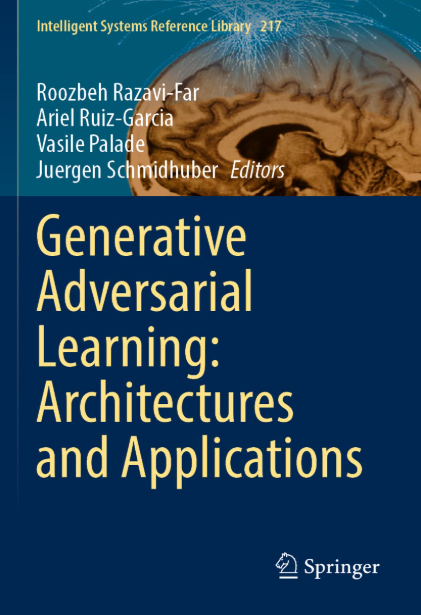
Springer Nature Switzerland AG, Intelligent Systems book series 217, Switzerland, pp. 1-355, 2022.
| Course | Times Offered |
|---|---|
| Machine Learning | 1 Semester |
| Machine Learning and Data Mining | 1 Semester |
| Data Mining | 3 Semesters |
| Robust Machine Learning | 3 Semesters |
| Big Data Processing Short Course | 1 Semester |
| Practical Machine Learning Short Course | 1 Semester |
| Cybersecurity Capstone Projects | 4 Semesters |
| Network Security | 1 Semester |
| Course | Times Offered |
|---|---|
| Data Mining | 15 Semesters |
| Artificial Intelligence | 1 Semester |
| Applied Machine Learning | 4 Semesters |
| Condition Monitoring | 6 Semesters |
| Computational Methods and Modeling | 9 Semesters |
| Course | Times Offered |
|---|---|
| Neural Networks | 5 Semesters |
| Control Systems | 5 Semesters |
| Fuzzy Logic | 5 Semesters |
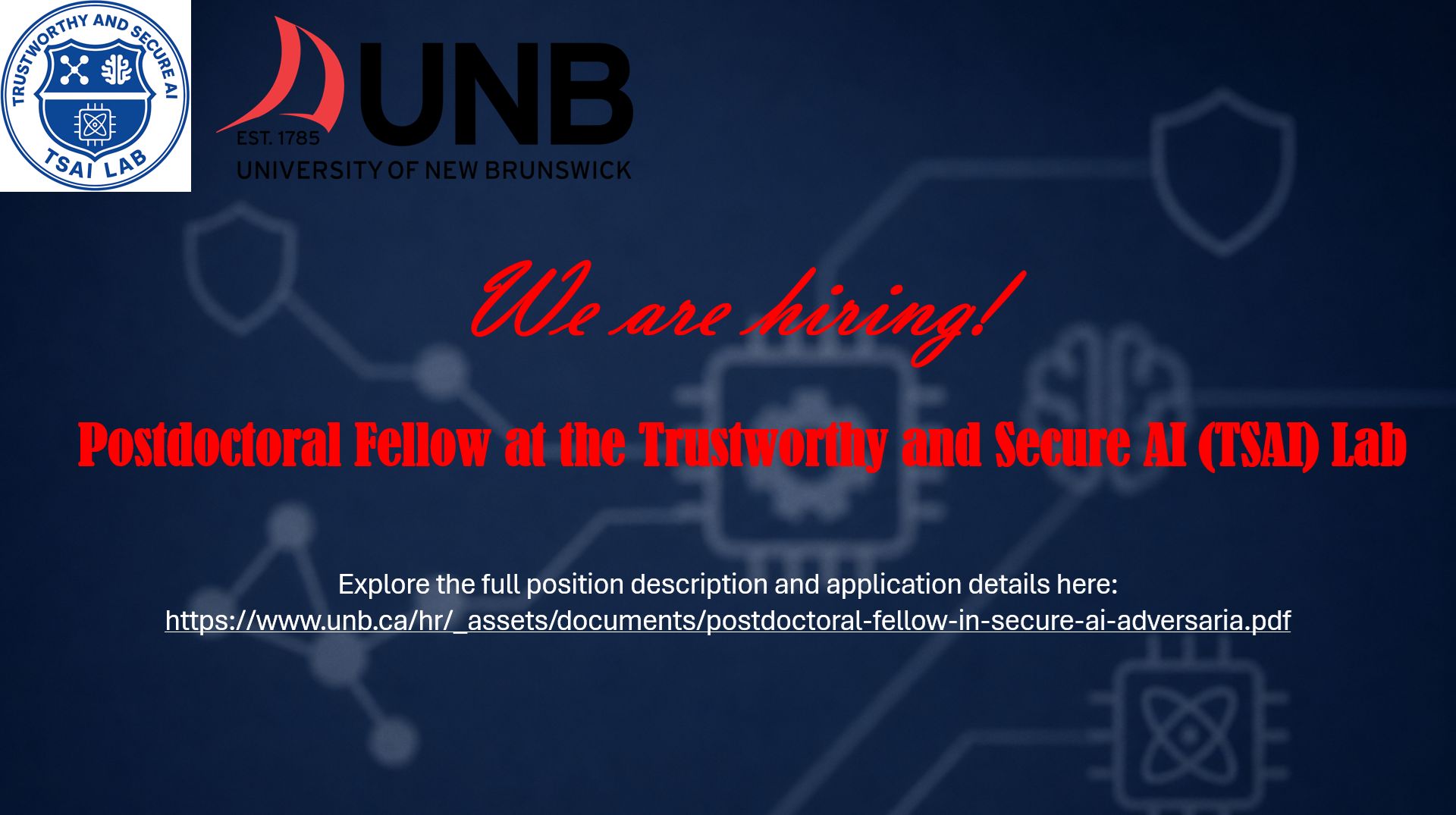
The TSAI Lab at the University of New Brunswick is looking for a motivated Postdoctoral Fellow to work on Secure AI and Adversarial Machine Learning.
This is an exciting opportunity to work on cutting-edge research in robust and trustworthy AI, and collaborate internationally. Details are available in the attached PDF. Please share with interested candidates.